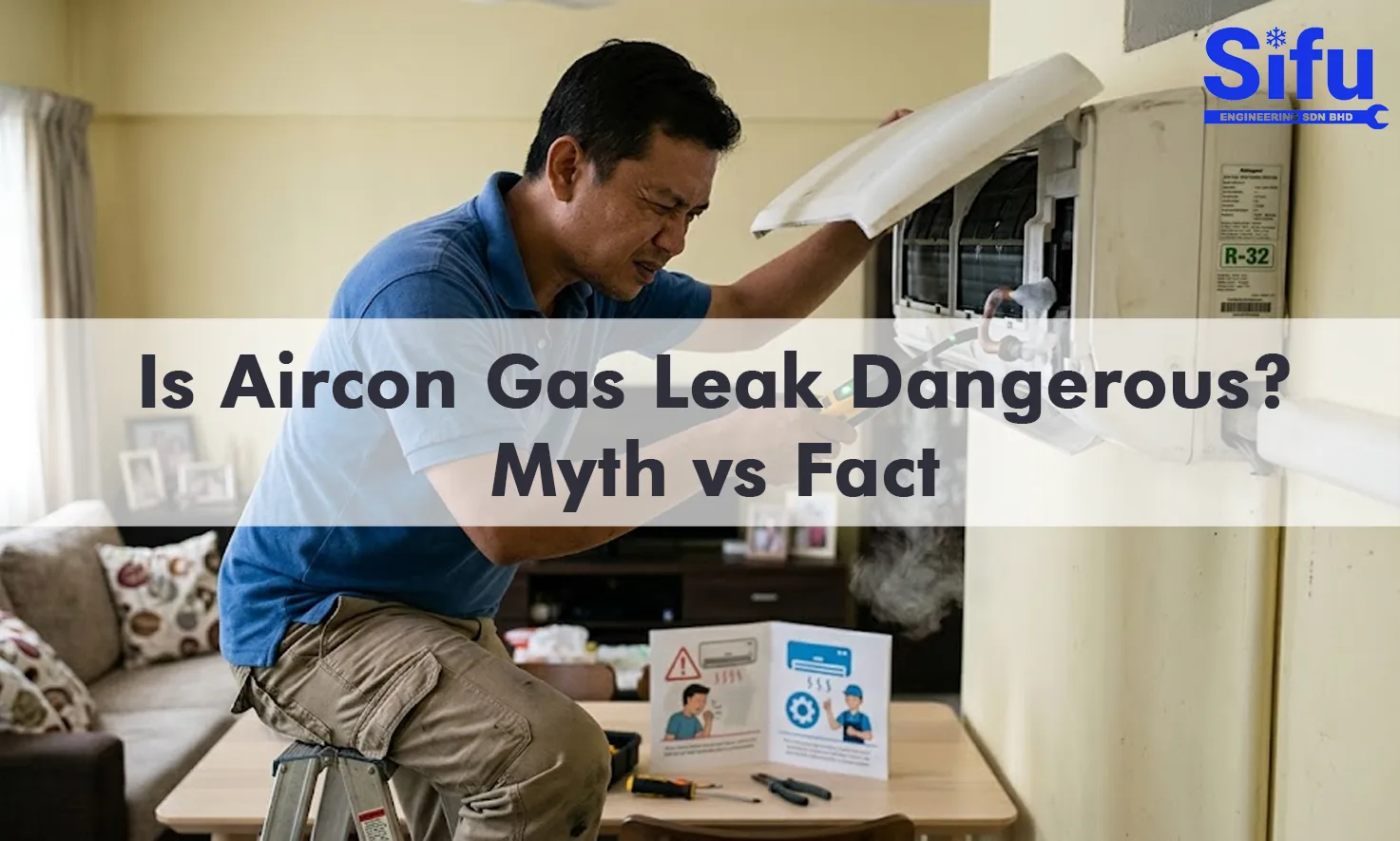

Is Aircon Gas Leak Dangerous

Is Aircon Gas Leak Dangerous? Myth vs Fact That You Should Know

Table of Contents

If your aircon is not cooling like before, you may be worried it is leaking gas, and whether that gas can harm your family. The short answer is that a small aircon gas leak is usually low risk in an open room with normal ventilation, but a large leak in a small closed space can pose a real danger, especially with modern R32 refrigerant that is mildly flammable. This article breaks down the common myths Malaysian homeowners believe about aircon gas leaks, and the facts backed by refrigerant safety standards, so you know exactly when to worry and when to simply call a technician.


This guide is written for homeowners, condo residents, and business owners who want a clear, honest answer instead of scare tactics or empty reassurance.

What Is An Aircon Gas Leak?

An aircon gas leak happens when the refrigerant, the chemical that absorbs heat inside your unit and releases it outside, escapes from the sealed copper piping or coil due to a crack, loose joint, corrosion, or physical damage. Most residential units in Malaysia today use R32 refrigerant, which replaced the older R22 gas because it cools more efficiently and has a lower environmental impact.

Common Myths About Aircon Gas Leak

Myths

Aircon Gas Leak Will Cause An Explosion In Your Home

This is the most common fear, and it is mostly exaggerated. R32 is classified as mildly flammable under the international A2L safety rating, meaning it needs a fairly high concentration in the air, generally estimated between 13 and 15 percent, plus an open flame or spark, before it can ignite.

In a normal home with doors, windows, and airflow, refrigerant disperses quickly and rarely reaches that concentration. An explosion from a home aircon leak is an extremely rare event, not a common outcome.

Myths

You Will Always Smell Or Hear A Gas Leak

Many homeowners assume a leak always comes with a strong smell or hissing sound. In reality, R32 is colourless and can be nearly odourless in small amounts, so many leaks go unnoticed until cooling performance clearly drops. A hissing sound near the pipes or indoor unit is a useful clue, but the absence of smell or sound does not mean there is no leak.

Myths

A Small Leak Is Not Urgent, It Can Wait

Some owners think a slow leak is fine to ignore since the unit still blows cold air. In truth, refrigerant does not get "used up" like fuel, so any drop in gas level means there is already a leak somewhere in the system.

Left unrepaired, the compressor works harder, electricity bills rise, and the small leak often becomes a bigger repair once the compressor is damaged.

Myths

Refrigerant Gas Is Poisonous Like Carbon Monoxide

Refrigerant is not classified as toxic under normal household exposure. The real danger from a large, concentrated leak in a small sealed room is oxygen displacement, meaning the gas can push out breathable air and cause dizziness or difficulty breathing, similar to being in an unventilated room with any heavy gas. This is different from chemical poisoning and is easily prevented by opening a window.

The Facts About Aircon Gas Leak Danger

Facts

R32 Is Mildly Flammable, Not Highly Flammable

Under the ASHRAE refrigerant safety classification system, R32 sits in the A2L category, which stands for lower toxicity and lower flammability. This is a step above fully non flammable refrigerants like older R410A, but far below highly flammable gases such as propane based R290. Manufacturers design R32 units with minimum room size and installation clearance rules specifically to keep any potential leak concentration well below the flammable threshold.

Facts

The Real Risk Is Poor Ventilation, Not The Gas Itself

Almost every documented safety guideline points to the same root cause of danger, a large leak trapped in a small, sealed space with no airflow. This is why technicians are trained to avoid installing indoor units in tiny, poorly ventilated rooms, and why opening a window or door immediately is the single most effective safety step during a suspected leak.

Facts

Health Symptoms From Exposure Are Usually Mild And Short Lived

If you are in a room during a significant leak, you may feel lightheaded, get a mild headache, or notice difficulty breathing. These symptoms typically ease quickly once you move to fresh air. Direct skin contact with liquid refrigerant can cause frostbite type injury, which is why only trained technicians should handle the refrigerant lines directly.

Facts

A Leak Always Means A Repair Is Needed

Whether the leak is small or large, refrigerant does not simply refill itself. Every leak, no matter how minor it seems, points to a failure point in the system that needs proper leak detection and repair, not just a top up of gas.

BTU vs Horsepower: What Is the Difference?

In Malaysia, many people shop for airconds by horsepower (HP), such as 1.0HP, 1.5HP, or 2.0HP. That is common and helpful for quick comparison. However, BTU gives a clearer picture of the actual cooling capacity of the unit.


Horsepower is often used as a shopping category, while BTU is the technical measure of how much cooling the aircond can deliver. That is why it is useful to understand both when choosing a unit.


If you are comparing models, you can browse air conditioning products on our website and review the available specifications before deciding.

Signs Your Aircon May Have A Gas Leak

  • Cooling feels weak or the room takes much longer to reach the set temperature
  • Ice or frost forms on the indoor coil or copper pipes
  • A hissing or bubbling sound comes from near the unit or piping
  • Electricity bill increases noticeably without extra usage
  • The outdoor unit runs constantly without ever reaching the set temperature

If you notice two or more of these signs together, it is a strong indicator of a refrigerant leak rather than a normal servicing issue.

What To Do If You Suspect A Gas Leak

  • Turn off the aircon at the remote and at the wall switch or MCB if possible.
  • Open windows and doors in the affected room to let fresh air circulate.
  • Avoid using lighters, gas stoves, or anything with an open flame near the unit.
  • Do not attempt to open the unit casing or touch the refrigerant lines yourself.
  • Call a licensed aircon technician for proper leak detection and repair.

A trained technician will use an electronic leak detector or soap bubble test to pinpoint the exact leak location, then carry out a nitrogen pressure test before repairing and recharging the system safely. If you are unsure who to call, our aircon repair service covers leak detection and refrigerant recharge across Pulau Pinang, Perak, and Kedah.

How To Prevent Aircon Gas Leak In Malaysian Homes

Preventing a leak is far cheaper than repairing one, especially in Malaysia’s hot and humid climate that puts extra strain on cooling systems.

1. Schedule Regular Servicing

Routine aircon servicing allows a technician to check joints, coils, and pressure levels before small issues turn into leaks.

2. Choose The Correct Capacity Unit

An undersized unit measured against your room size, which you can check with our BTU calculator, runs harder than it should and wears out faster.

3. Use Proper Installation

Poor pipe bending, weak brazing joints, or exposed outdoor units placed under direct sun are common causes of early leaks. Always use a certified installer for aircon installation.

4. Avoid Physical Damage

Keep the outdoor unit clear of debris, avoid drilling near hidden pipe runs, and protect the unit from impact during renovation work.

5. Watch Your Electricity Bill

A sudden unexplained increase is often the earliest warning sign, well before cooling problems become obvious.

Conclusion

Aircon gas leak is not the dramatic, explosive danger many people imagine, but it is also not something to shrug off. R32 refrigerant used in most Malaysian homes today is mildly flammable and low in toxicity under normal conditions, with real risk mainly limited to large leaks trapped in small, unventilated spaces. The safest approach is simple, recognise the signs early, ventilate the room if you suspect a leak, and call a licensed technician rather than attempting a fix yourself. Regular servicing remains the most reliable way to catch a leak before it affects your health, your electricity bill, or your compressor.


If your aircon is showing signs of a leak, reach out to Sifu Engineering for professional leak detection and repair across Pulau Pinang, Perak, and Kedah.

Frequently Asked Questions (FAQs)

Is aircon gas leak dangerous to breathe?

In small amounts with normal ventilation it is usually low risk, but a large leak in a sealed room can displace oxygen and cause dizziness or breathing difficulty, so open a window immediately if you suspect a leak.

Can aircon gas leak cause fire or explosion?

R32 refrigerant is mildly flammable and needs a high concentration plus an open flame source to ignite, which makes fire from a home aircon leak rare rather than common.

How do I know if my aircon is leaking gas?

Weak cooling, ice on the coil or pipes, a hissing sound, and a sudden rise in electricity bill are the clearest signs of a refrigerant leak.

Is it safe to sleep in a room with a leaking aircon?

It is not recommended. Turn off the unit, open a window for ventilation, and have it inspected by a technician before using the room as normal.

How much does it cost to fix an aircon gas leak in Malaysia?

Cost depends on the leak location and severity, ranging from a simple joint repair to a full coil replacement, so a technician visit is needed for an accurate quote.

{{ reviewsTotal }}{{ options.labels.singularReviewCountLabel }}
{{ reviewsTotal }}{{ options.labels.pluralReviewCountLabel }}
{{ options.labels.newReviewButton }}
{{ userData.canReview.message }}

Share it on: 

Related Blogs

Whatsapp Icon